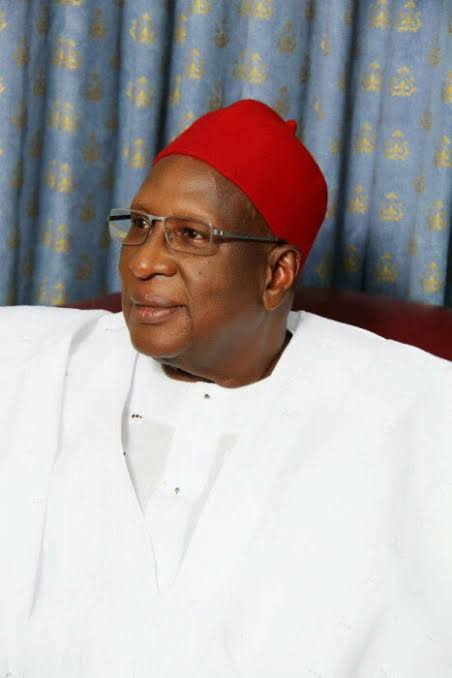
Introduction to Bamanga Tukur Biography
Bamanga Tukur biography tells the story of a Nigerian statesman whose remarkable career crossed several worlds: public administration, maritime management, politics, entrepreneurship and Pan-African business leadership. Born on September 15, 1935, in what is now Adamawa State, Tukur spent more than five decades building a reputation as an administrator, businessman and political figure. He became nationally prominent as General Manager and Chief Executive of the Nigerian Ports Authority between 1975 and 1982, later served as Governor of the old Gongola State in 1983, and returned to federal service as Minister of Industries in the 1990s. His career also extended beyond Nigeria, particularly through leadership roles in the African Business Roundtable and the NEPAD Business Group.
The Bamanga Tukur biography also took a new turn in September 2026, when Nigeria mourned his death at the age of 90. The State House described him as an elder statesman whose career covered governance, industry, public administration and Pan-African economic leadership. He died on September 12, 2026, just three days before his 91st birthday. His death closed a long chapter in Nigeria’s political and economic history, particularly because few Nigerian public figures moved so extensively between the civil service, business, state government, federal government and political party leadership.
What makes the Bamanga Tukur biography particularly interesting is the sheer range of responsibilities he carried. He began professionally as an accountant, entered the Nigerian Ports Authority as a management cadet, climbed the organisation’s hierarchy and eventually became its chief executive. From there, he entered electoral politics, became governor, developed private business interests, served as a federal minister and later became chairman of Nigeria’s ruling People’s Democratic Party. His story therefore mirrors many of the major transitions experienced by Nigeria itself.
Quick Facts About Bamanga Tukur
| Category | Details |
|---|---|
| Full name | Bamanga Muhammad Tukur |
| Born | September 15, 1935 |
| Birthplace | Jada, present-day Adamawa State, Nigeria |
| Died | September 12, 2026 |
| Age at death | 90 |
| Profession | Businessman, administrator and politician |
| Major NPA position | General Manager/Chief Executive, Nigerian Ports Authority |
| NPA tenure | 1975–1982 |
| Governor | Gongola State, 1983 |
| Federal minister | Minister of Industries |
| PDP position | National Chairman, 2012–2014 |
| Traditional title | Tafidan Adamawa |
| National honour | Commander of the Order of the Niger (CON) |
| Education | Institutions in Nigeria, the UK and the United States |
Early Life and Childhood
The early years form an important foundation in any Bamanga Tukur biography because his later career reflected the combination of traditional leadership, formal education and professional administration that shaped his generation. Tukur was born in Jada in 1935, in the area that later became part of Adamawa State. He grew up during a period when Nigeria remained under British colonial rule, meaning that educational and administrative opportunities were changing rapidly for young Nigerians. His generation would eventually become responsible for managing institutions that were being transformed from colonial structures into national institutions.
His early schooling took him from Jada Elementary School to Yola Middle School and then Bauchi Secondary School. According to biographical records, he attended elementary school between 1946 and 1948, Yola Middle School from 1949 to 1953, and Bauchi Secondary School from 1953 to 1957. This educational progression gave him an early grounding in administration and prepared him for the professional training that followed. Rather than stopping with secondary education, Tukur pursued further studies in administration and management, reflecting an ambition that extended beyond the conventional career paths available to many young Nigerians at the time.
The Bamanga Tukur biography consequently begins not with political office but with professional preparation. That distinction matters because his later rise at the Nigerian Ports Authority was rooted in technical and managerial experience rather than simply political connections. His early career as an accountant with the Adamawa Native Authority in 1959 gave him practical exposure to public administration. Soon afterward, his move into the Nigerian Ports Authority opened the door to the national stage.
Bamanga Tukur’s Age and Birth
Bamanga Tukur was born on September 15, 1935, and died on September 12, 2026, at the age of 90. He therefore lived through an extraordinary period in Nigerian history, witnessing colonial rule, independence, the First Republic, military governments, the Second Republic, subsequent military interventions and the return to democratic government. His life effectively stretched across the political history of modern Nigeria.
Interestingly, Tukur died only three days before his 91st birthday. His longevity meant that he remained a valuable source of institutional memory for younger politicians and business leaders. Consequently, references to him in his final years often presented him as an elder statesman whose experience extended across several generations of Nigerian public life.
Bamanga Tukur Education
Education played a significant role in the Bamanga Tukur biography, particularly because his studies were not confined to one country or one discipline. After his early schooling in Jada, Yola and Bauchi, he attended the Institute of Administration associated with Ahmadu Bello University in Zaria. He also pursued further education in the United Kingdom and the United States, including postgraduate study at the University of Pittsburgh.
This international exposure helped broaden his understanding of management, administration and economic development. In an era when Nigeria was developing its own professional institutions, overseas training offered ambitious administrators access to ideas and management practices that were increasingly relevant to a modernising economy. Tukur later applied that experience in organisations connected with transportation, ports, industry and international business.
His educational journey also helps explain why his career eventually extended beyond conventional Nigerian politics. He became involved in international organisations and African business initiatives, where knowledge of management and economic development mattered as much as political influence. In that sense, education became one of the threads connecting the different stages of his professional life.
Studies in Nigeria, Britain and the United States
The available biographical record identifies studies at the Institute of Administration in Zaria, further training in the United Kingdom and postgraduate education at the University of Pittsburgh in the United States. He was also later awarded an honorary Doctor of Laws degree by Benue State University.
Rather than treating education as a standalone achievement, it is useful to see it as part of Tukur’s broader professional philosophy. His career repeatedly required him to move between technical management and public leadership. Therefore, his educational background became a practical asset as he dealt with transportation systems, government institutions, business organisations and international economic initiatives.
Early Career and Nigerian Ports Authority
One of the strongest chapters in the Bamanga Tukur biography began in 1963 when he joined the Nigerian Ports Authority as a management cadet. His progress inside the organisation was gradual rather than instantaneous. He served in different operational and managerial capacities, including Assistant Chief Traffic and Commercial Manager and Ports Manager, before ultimately becoming General Manager and Chief Executive.
His rise coincided with an important period in Nigeria’s economic development. The country’s ports were essential to international trade, and the pressure on maritime infrastructure increased as imports and exports expanded. Tukur’s leadership at the NPA therefore placed him at the centre of a crucial part of the national economy. Contemporary and retrospective accounts associate his tenure with efforts to improve port operations and address congestion.
Rise to General Manager of the NPA
Tukur served as General Manager and Chief Executive of the Nigerian Ports Authority from 1975 to 1982. During those years, he became one of the country’s best-known public administrators. His tenure occurred during a period of heavy pressure on Nigeria’s ports, including congestion associated with the large-scale cement importation programme of the era.
His work at the NPA established a pattern that would follow him throughout the rest of his career: taking responsibility for a major institution, dealing with complex operational problems and then using that experience to move into broader leadership. The position gave him national visibility and strengthened his credentials before his entry into electoral politics.
Bamanga Tukur as Governor of Gongola State
The transition from administrator to politician represented another major stage in the Bamanga Tukur biography. After leaving the NPA, Tukur entered electoral politics and contested the governorship of Gongola State. He won the election and became governor in 1983. At that time, Gongola State covered territory that would later become Adamawa and Taraba states.
However, his governorship lasted only a few months. The military coup of December 1983 brought the Second Republic to an end and removed elected governments across Nigeria. Consequently, Tukur’s opportunity to establish a long-term record as a civilian governor was cut short. Nevertheless, the experience gave him direct exposure to electoral politics and executive government.
That brief governorship remained a defining part of his public identity. Even decades later, biographies and tributes continued to identify him as a former governor of the old Gongola State. The position also connected his name permanently with the political history of Adamawa and Taraba.
Business Career and Entrepreneurship
After leaving the governorship, Tukur expanded his activities in the private sector. The Bamanga Tukur biography records him as the founder and chairman of BHI Holdings, also associated with the DADDO Group of Companies. His business interests extended across areas such as manufacturing, agriculture, logistics and trading.
This stage demonstrated another side of his personality. While politics provided public influence, business offered a different route to economic participation. Tukur became an advocate of private-sector development, and his later leadership in continental business organisations reflected this interest.
The combination of business and public service also became a recurring feature of his career. He understood government from inside the system while also operating in the private sector. That dual experience helped him participate in conversations about investment, infrastructure and African economic development.
BHI Holdings and DADDO Group
BHI Holdings and the DADDO Group formed part of Tukur’s private-sector footprint after his first major political office. Although detailed public financial records about the companies are limited, contemporary and official accounts recognise his role as chairman and businessman.
His entrepreneurial activities strengthened his reputation as more than a career politician. Indeed, one of the reasons the Bamanga Tukur biography remains notable is that he repeatedly moved between government and business without abandoning either sphere completely. His later continental business leadership grew naturally from this background.
Minister of Industries and Federal Service
Tukur returned to federal government service in the 1990s when he became Minister of Industries under the military administration of General Sani Abacha. Sources commonly place his ministerial service between 1993 and 1995, although some biographical records give a slightly different end date.
The appointment added another layer to an already varied career. By then, Tukur had experience in local administration, maritime management, elected government and private business. Consequently, his ministerial role placed him in a position where he could draw upon several decades of professional experience.
His time as minister also connected him with national debates about industrial development. Nigeria had long sought to reduce excessive dependence on imports and strengthen domestic production. Therefore, industrial policy became another important area in which Tukur participated during his public career.
Pan-African Business Leadership
A central part of the Bamanga Tukur biography lies outside Nigerian government altogether. Tukur became an influential figure in African business circles and served as Executive President of the African Business Roundtable. He also chaired the NEPAD Business Group and participated in several international business and investment advisory initiatives.
His continental work reflected his belief in stronger African private-sector participation. Rather than viewing development only through government programmes, he advocated investment, entrepreneurship and intra-African economic cooperation. His international roles therefore allowed him to take ideas developed through his Nigerian career into a broader African context.
African Business Roundtable and NEPAD
Tukur’s involvement with the African Business Roundtable and NEPAD Business Group placed him among African business leaders who promoted private investment and economic integration. He was also associated with international port and investment organisations, further reinforcing his reputation as a Pan-African economic advocate.
These positions mattered because Africa’s development debate increasingly focused on how governments could create conditions for private enterprise. Tukur’s experience across government and business gave him a distinctive perspective. He could discuss policy from the viewpoint of a former administrator while also understanding the practical concerns of entrepreneurs and investors.
Bamanga Tukur and the PDP
Later in life, Tukur returned to frontline Nigerian partisan politics. In March 2012, he became National Chairman of the Peoples Democratic Party, then Nigeria’s governing party. His emergence came with the backing of President Goodluck Jonathan and placed him at the centre of national political debates.
The position was arguably one of the most challenging assignments of his career. The PDP was a dominant political organisation, but internal disagreements were intense. Tukur inherited the responsibility of managing competing interests involving governors, legislators, party officials and influential political actors.
National Chairman of the PDP
Tukur served as PDP National Chairman from March 2012 until January 2014. His tenure became increasingly difficult as internal factions challenged his leadership. In August 2013, a group of governors, senators and House of Representatives members associated with former Vice President Atiku Abubakar established what became known as the “New PDP,” deepening the crisis within the party.
Eventually, Tukur resigned as chairman in January 2014. His departure demonstrated how difficult it could be for even an experienced elder statesman to manage a major Nigerian political organisation with competing interests. Nevertheless, his PDP leadership remains an important part of the Bamanga Tukur biography because it represented his return to the highest level of partisan politics decades after his governorship.
Controversies and Political Challenges
No serious Bamanga Tukur biography can ignore the controversies surrounding his political career. His time as PDP chairman was marked by factional disputes, disagreements among senior party figures and questions over his ability to maintain unity within the organisation. The 2013 emergence of the New PDP represented the most serious challenge to his leadership.
The controversy should, however, be viewed within the broader political environment of the period. Nigerian political parties often contain multiple competing interests, particularly when they control the federal government. Tukur’s challenge was therefore not simply personal; it involved the difficult task of balancing governors, legislators, party leaders and presidential interests.
His eventual resignation did not erase his earlier achievements. Instead, it became one chapter in a career that included considerably more than party politics. His supporters continued to highlight his administrative experience, business leadership and contributions to African economic initiatives.
Bamanga Tukur Wife and Family
Family was another important part of the Bamanga Tukur biography, although detailed public information about his private household remains relatively limited. Biographical records identify Hajiya Fatima Tukur as his spouse, while other contemporary reports state that he was survived by wives, children and grandchildren.
Public sources have also identified several of his children, including Awwal Tukur, Lami Danburam, Zainab Mustapha Jaji, Mahmud Bamanga Tukur and Mohammed Raji Fahad Tukur. Because public reporting about large Nigerian families can vary in how many relatives it names, it is safer to distinguish between publicly identified family members and the wider family.
Despite his extensive public career, Tukur generally maintained a distinction between his professional life and private family life. Consequently, much of what is publicly documented concerns his political and business responsibilities rather than intimate details about his home life.
Bamanga Tukur Net Worth
The question of Bamanga Tukur net worth is likely to attract considerable interest because of his long business and political career. However, there is no sufficiently reliable public financial disclosure that establishes a definitive figure for his personal wealth. Websites sometimes publish specific estimates, but without audited records or credible financial documentation, such numbers should not be presented as fact.
What can be established is that Tukur held senior positions in government and business and founded or chaired private-sector organisations. He also participated in major African business networks. Those facts demonstrate significant professional influence, but they do not provide a dependable calculation of personal net worth.
Therefore, a responsible Bamanga Tukur biography should avoid inventing a precise dollar or naira amount. His financial legacy is better understood through his decades of business activity, leadership positions and involvement in investment and industrial development.
Publications and Professional Contributions
Unlike some Nigerian public figures, Tukur is not principally remembered as a prolific author of books. His professional contribution was more closely connected with administration, speeches, policy advocacy, business organisations and institutional leadership. His work in maritime administration and African business development generated influence through organisations rather than through a large catalogue of published books.
His professional record included involvement with international business and investment advisory organisations. Biographical sources associate him with the UNIDO International Business Advisory Council, Ghana Investors Advisory Council and other economic institutions.
Consequently, when examining publications and intellectual contributions, it is more accurate to focus on his policy and institutional work than to manufacture a bibliography. His contribution was largely practical: he participated in conversations about ports, industry, investment, trade and African economic development.
Awards, Honours and Traditional Titles
The Bamanga Tukur biography includes several recognitions reflecting his long public career. Among the most significant was Nigeria’s national honour of Commander of the Order of the Niger, commonly abbreviated as CON. He also received the Commander of the Order of the Mono from Togo, according to contemporary biographical accounts.
Tukur also received an honorary Doctor of Laws degree from Benue State University and was recognised as a fellow of the Nigerian Institute of Transport Technology. His traditional titles included Tafidan Adamawa and Wakilin Ganye, reflecting his standing within Adamawa’s traditional and community structures.
These honours illustrate how his influence operated across different institutions. Government recognised his national service, professional bodies recognised his management experience, universities recognised his broader contribution and traditional authorities recognised his community standing.
Leadership Style and Public Influence
Tukur’s leadership style can best be understood through the variety of institutions he led. At the Nigerian Ports Authority, he operated as a professional administrator. As governor, he functioned as an elected political executive. In business, he worked as an entrepreneur and chairman, while his African roles required him to act as an advocate for private-sector development.
That versatility became one of the defining characteristics of the Bamanga Tukur biography. He was not confined to one professional identity. Instead, his career resembled a bridge connecting public administration, politics and business.
His influence also extended across generations. Younger Nigerian leaders encountered him as a former governor, businessman, minister or PDP chairman, while African business leaders knew him through continental organisations. In his later years, he was increasingly described as an elder statesman and a repository of institutional experience.
Later Years and Death
The final chapter of the Bamanga Tukur biography came in September 2026. Tukur died on September 12, 2026, at the age of 90, according to his family and multiple Nigerian news organisations. His death came just three days before his 91st birthday.
President Bola Ahmed Tinubu subsequently paid tribute to him, describing him as an important figure whose career encompassed public administration, governance, industry, politics and Pan-African business leadership. The Adamawa State government also declared a period of mourning following his death.
The circumstances of his death were not publicly detailed in the initial reports. What was clear, however, was the scale of the response. Tributes came from political, business and community circles, reflecting the number of institutions and generations touched by his career.
Legacy of Bamanga Tukur
The lasting significance of the Bamanga Tukur biography rests on the breadth of his career. He moved from accounting and public administration to maritime leadership, elected office, private enterprise, federal government, continental business advocacy and party leadership. Very few Nigerian public figures have occupied such a broad range of roles across such a long period.
His maritime legacy is particularly important because his leadership of the Nigerian Ports Authority came during a crucial period in the development of Nigeria’s trade infrastructure. His political legacy is more complicated because his brief governorship and later PDP chairmanship were shaped by intense political circumstances. His business legacy, meanwhile, is connected to his advocacy for private-sector participation in African development.
Ultimately, Tukur’s life demonstrates how one individual can become intertwined with several dimensions of a country’s history. His career was not without controversy or political setbacks, but those difficulties do not erase the scale of his public service. His death in 2026 marked the end of a career that had begun more than six decades earlier and continued through some of Nigeria’s most dramatic political and economic transformations.
Conclusion
The Bamanga Tukur biography is the story of a man who refused to remain within one professional lane. From his childhood education in present-day Adamawa State to his studies in Nigeria, Britain and the United States, he built the foundation for a career that eventually took him to the highest levels of Nigerian public administration and politics. His years at the Nigerian Ports Authority established his reputation as an administrator, while his governorship of Gongola State introduced him to elected political leadership.
Later, his business activities and continental roles demonstrated an enduring interest in economic development. As Executive President of the African Business Roundtable and chairman of the NEPAD Business Group, he became a voice for private enterprise and African economic cooperation. His final major political role as PDP National Chairman was more turbulent, ending with his resignation in 2014 after prolonged internal party disputes.
Yet the full Bamanga Tukur biography cannot be reduced to one political controversy. His life encompassed administration, business, industry, maritime development, politics and traditional leadership. He died at 90 in September 2026, leaving behind a complicated but undeniably significant record in Nigerian public life.
Frequently Asked Questions About Bamanga Tukur
1. Who was Bamanga Tukur?
Bamanga Muhammad Tukur was a Nigerian businessman, administrator and politician who served as General Manager of the Nigerian Ports Authority, Governor of the old Gongola State, Minister of Industries and National Chairman of the PDP. He also held major leadership positions in African business organisations.
2. When was Bamanga Tukur born?
Bamanga Tukur was born on September 15, 1935, in Jada, in present-day Adamawa State, Nigeria.
3. When did Bamanga Tukur die?
Bamanga Tukur died on September 12, 2026, at the age of 90. He died three days before his 91st birthday.
4. What political positions did Bamanga Tukur hold?
He served as Governor of the old Gongola State in 1983 and later became National Chairman of the Peoples Democratic Party from March 2012 to January 2014. He also served as Minister of Industries during the 1990s.
5. What was Bamanga Tukur’s role at the Nigerian Ports Authority?
Tukur joined the Nigerian Ports Authority in 1963 as a management cadet and rose through several positions before becoming General Manager and Chief Executive from 1975 to 1982.
6. What was Bamanga Tukur’s net worth?
There is no reliably documented public figure for his personal net worth. Although he had extensive business interests and held senior positions, precise online estimates should not be treated as verified financial facts.
7. What is Bamanga Tukur remembered for?
He is remembered for his long career in Nigerian public administration, his leadership of the Nigerian Ports Authority, his brief governorship of Gongola State, his business activities, his Pan-African economic advocacy, his ministerial service and his leadership of the PDP. His traditional title was Tafidan Adamawa.